Why Expense Tracking Is Critical for a Food Truck
Many food truckers know their revenue to the cent — but have no idea where their money goes. This is one of the most common causes of disappointing profitability, even for trucks doing solid business.
Without rigorous expense tracking, you're driving blind. You can't tell whether your margins shrank because your suppliers raised prices, because you're wasting more ingredients, or because your fuel bill exploded.
This guide gives you a complete method to categorize, track, and analyze every expense in your food truck business — so you can take back control of your profitability.
The 5 Key Expense Categories to Track
1. Food Cost (Ingredients and Consumables)
This is your biggest expense line: between 28 and 38% of your revenue, depending on your concept. It includes:
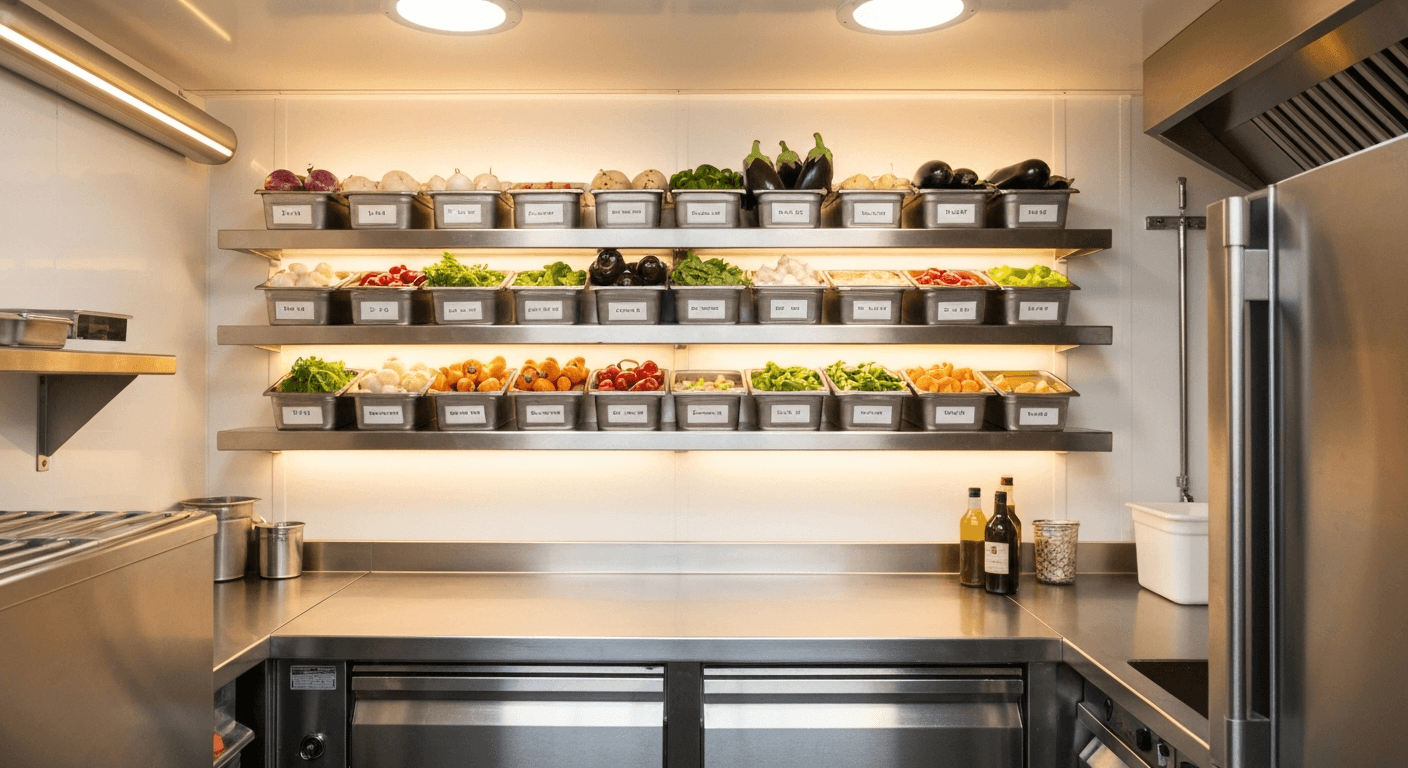
- Raw ingredients (meat, vegetables, cheese, bread…)
- Packaging and consumables (containers, cutlery, napkins)
- Food-safe cleaning products (gloves, cling wrap)
2. Staff Costs
If you work alone, this line is zero or near zero. But the moment you hire an employee or bring in a casual worker, costs climb fast: gross salary + employer contributions = roughly 1.4× net salary in France.
Track:
- Salaries and social charges
- Casual/temp agency contracts
- Your own salary if you operate through a company
3. Vehicle Expenses
Your truck is your primary tool. Its costs are often underestimated:
- Fuel: €150–€400/month depending on your routes
- Maintenance and repairs: budget €200–€400/month
- Insurance: €150–€300/month for full professional coverage
- Technical inspection: annual for vehicles over 3.5 tonnes
- Lease or loan repayment: if you financed the truck with credit
4. Fixed Professional Overheads
These expenses exist whether you're working or not:
- Location fees (market subscriptions, recurring festivals)
- Software subscriptions (management, POS, accounting)
- Phone and internet connection
- Accountant fees
- Professional memberships (food truck associations, trade bodies)
- Commissary kitchen rental (mandatory in France if you don't have your own lab)
5. Capital Purchases and Depreciation
Large purchases (cooking equipment, refrigerators, signage, sound systems…) aren't deducted all at once but depreciated over several years. Keep a fixed asset register with:
- Purchase date
- Full purchase price (incl. VAT)
- Depreciation period (3–7 years depending on the asset)
- Annual and monthly depreciation amount
The Week-by-Week Method
Expense tracking only works if it's consistent. Here's a simple 10-minute weekly routine:
Step 1: Collect All Invoices (Monday Morning)
Gather every invoice from the previous week: food suppliers, fuel station, packaging suppliers, etc. Don't forget card receipts for one-off purchases.
Step 2: Enter or Scan Every Expense
With FoodTracks, photograph each invoice: the software automatically extracts the amount, date, and supplier. For expenses without a receipt (tolls, parking…), enter them manually with the correct category.
Step 3: Calculate Your Food Cost for the Week
Divide total ingredient purchases by your revenue for the week. If this ratio exceeds 35%, investigate the cause:
- Supplier price increase?
- More waste than usual?
- New dish with a poorly calibrated recipe?
Step 4: Compare with the Previous Week
A variance of more than 3 percentage points in food cost warrants immediate investigation. Cost overruns are easy to fix when caught early, but become entrenched habits when ignored.
The Most Common Expense Tracking Mistakes
Confusing Revenue with Cash
You took in €3,000 this week — but your account is empty? That often means a big supplier invoice landed at the same time. Expense tracking must be synchronized with your bank statement to avoid nasty surprises.
Missing Small Purchases
A supermarket run for emergency ingredients, a container of washing-up liquid, a part from the hardware store… These "small" untracked expenses can account for 5–8% of your total purchases over the year.
Mixing Personal and Business Expenses
As a sole trader, it's tempting to mix everything. This is a serious mistake: you lose visibility on your real costs, you create risk in case of a tax audit, and you can't optimize your VAT position.
Waiting for the Year-End Accountant Report
Your accountant works retrospectively. If your costs spiral in March, you won't find out until January the following year. Real-time management is your job.
Dashboard: The 4 Metrics to Monitor
| Metric | Formula | Food Truck Target | |---|---|---| | Food cost % | Ingredient purchases / Revenue × 100 | 28–35% | | Monthly fixed overheads | Total fixed costs / Monthly revenue × 100 | < 30% | | Cost per service | Total costs / Number of services | Concept-dependent | | Daily break-even | Fixed costs / Number of working days | Calculate once a month |
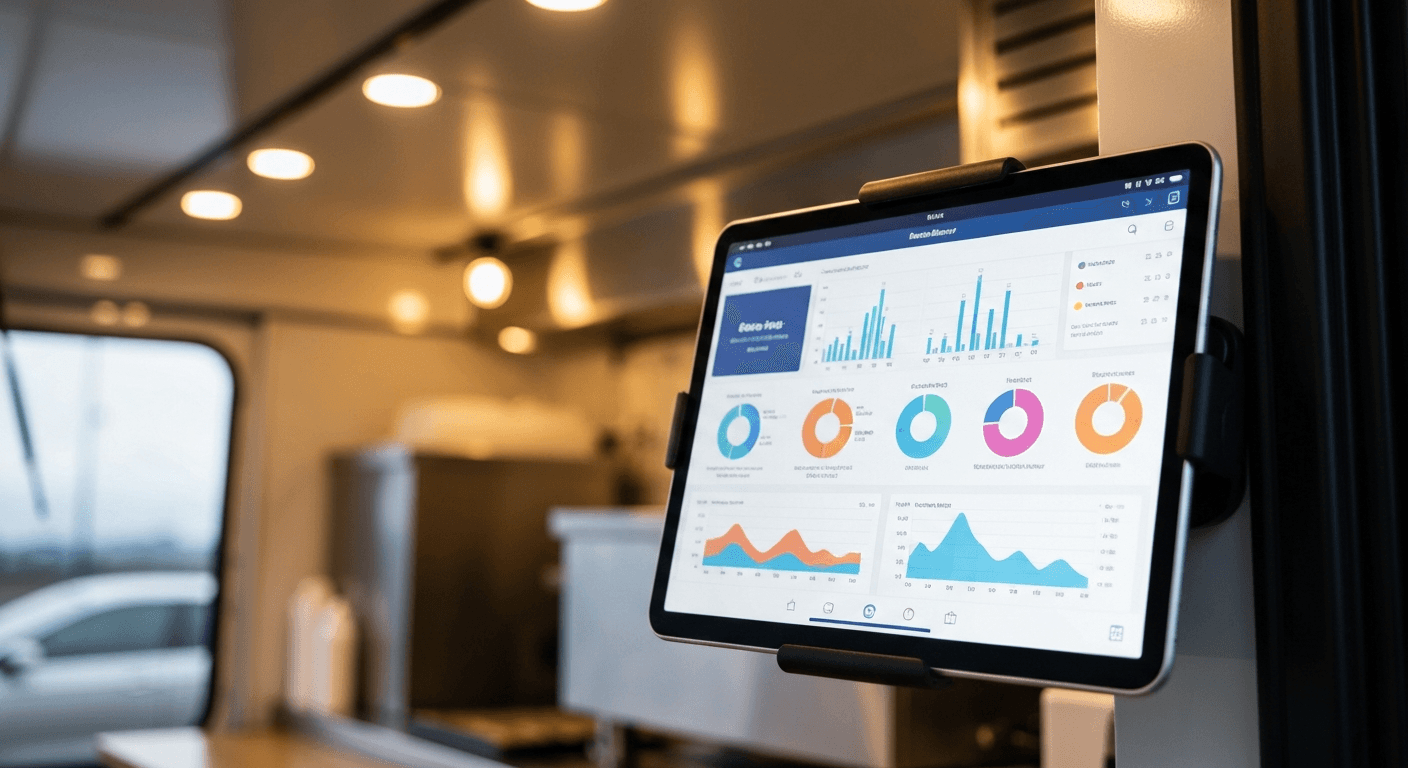
With FoodTracks, these metrics are calculated automatically from your SumUp sales and scanned invoices. No Excel spreadsheet to build.
How to Reduce Expenses Without Cutting Quality
Renegotiate with Suppliers
Many food truckers hesitate to negotiate. Yet a group purchase with other food truckers in your city, or simply a more regular and predictable order schedule, can earn you 3–8% discount with no complicated process.
Optimize Your Routes to Cut Fuel Costs
Planning your weekly locations to minimize distances can reduce your fuel bill by 15–25%. Always calculate the fuel-adjusted revenue for each location before committing.
Reduce Waste by Refining Your Orders
Every product thrown away is an expense with zero return. Precise consumption tracking per service lets you fine-tune your orders and bring waste below 3% of total purchases.
Share Costs with Other Operators
Share a commissary kitchen with other food truckers, pool packaging orders, or co-rent storage space. These arrangements can save €100–€300 per month.
Conclusion: Expense Tracking Is Your Best Profitability Tool
A profitable food truck isn't necessarily the one with the highest revenue. It's the one that controls costs better than the competition. Rigorous expense tracking is the foundation — without it, every other optimization (menu engineering, location strategy, marketing) is built on sand.
Start this week: gather all your invoices from the past four weeks, calculate your real food cost, and compare it to your estimates. You'll likely be surprised by the gap.
FoodTracks is built to automate this tracking: invoice scanning, SumUp integration, real-time dashboards. Try it free for 14 days and take back control of your finances.
Frequently Asked Questions
- What is the ideal food cost for a food truck?
- The ideal food cost is between 28 and 35% of revenue, depending on the concept. A premium burger truck can reach 28%, while a fresh fish concept may run at 38%. The key is to measure your actual food cost and compare it to your target every week.
- How can I track my food truck expenses without specialist software?
- Without software, you can use an Excel or Google Sheets spreadsheet with 5 columns: date, supplier, amount excl. VAT, category (ingredients / vehicle / fixed costs / staff / other), and payment method. Consistency is key: 10 minutes every Monday is enough. A tool like FoodTracks automates this with invoice scanning and SumUp integration.
- Do I need to keep all my invoices as a food truck operator?
- Yes, professional invoices must be kept for 10 years in France (tax statute of limitations). For fuel expenses, toll receipts, and small purchases without invoices, log them in an expense notebook or dedicated app. In the event of a tax audit, you'll need to justify every cost deducted from your profit.
- How do I calculate my daily break-even point as a food truck operator?
- Add up all your monthly fixed costs (location fees, insurance, subscriptions, accountant, depreciation…) and divide by the number of service days in the month. This figure is your daily break-even: the minimum revenue needed before generating any margin. For a food truck with €2,000 in monthly fixed costs and 20 services, the break-even is €100 of gross margin per service.
- Can I reclaim VAT on my food truck purchases?
- It depends on your tax regime. Under the standard or simplified VAT scheme, you can deduct VAT on professional purchases (fuel, equipment, packaging, software…) from the VAT collected on your sales. Under the VAT exemption scheme (revenue below €91,900 for catering in 2026), you don't charge VAT but can't reclaim it either. Consult your accountant to optimize your tax position.