Why Wait Time Is a Direct Profitability Lever
At a food truck, every minute counts twice. First for the customer: beyond 8 to 10 minutes of waiting, a significant proportion of people in the queue give up or leave without ordering. Then for you: a faster service means more covers served in the same slot, resulting in higher revenue without working longer.
The rule of thumb: every minute saved on your average service time can increase your hourly revenue by 5 to 15% during peak periods.
Yet most food truckers approach the issue "by feel": speed up, rush around, shout orders louder. The right approach is systematic: measure, identify bottlenecks, then correct methodically.
Step 1 — Measure Your Current Service Time
Before optimising anything, you need data. Over two or three services, time:
- Order-taking time: from the customer arriving at the window to the order being confirmed on the till
- Preparation time: from the confirmed order to handing it to the customer
- Payment time: if the till is separate from the hand-off point
A simple spreadsheet is enough to start. With FoodTracks, the SumUp timestamps already give you a foundation: the interval between two consecutive transactions is a reliable proxy for your real service time during busy periods.
Step 2 — Identify Your Bottlenecks
A bottleneck is the point in the process that limits the throughput of everything else. There is no point speeding up preparation if order-taking is the block, and vice versa. The most common bottlenecks at a food truck:
Order-Taking Taking Too Long
A menu that is too dense forces customers to hesitate. Every second of hesitation at the window ripples through the entire queue. A menu of 6 to 8 clearly legible items is almost always more profitable than a 20-line menu, because it speeds up the decision and simplifies preparation.
Another common cause: customers ask for clarifications (allergens, options, ingredients). Display this information clearly before the window, not on it.
Non-Sequenced Preparation
If you prepare each order from start to finish before moving to the next, you lose time during internal waiting phases (while the meat cooks, while the fryer comes back up to temperature, etc.). Parallel-flow preparation — starting to cook the next order while the first one finishes — can reduce perceived service time by 20 to 40%.
Payment as a Final Friction Point
A customer rummaging for coins or waiting for their card to go through slows down the entire queue. Contactless payments (tap-to-pay) are 3 to 5 times faster than PIN entry. Display a visible sign inviting customers to prepare their payment method while they wait.
Poorly Organised Order Hand-Off
If the customer receives their order at the same window where they ordered, the two flows cross and create confusion. As soon as volume allows, physically separate the order window from the hand-off point, even by 50 cm.
Step 3 — Reorganise Your Workstation
Truck ergonomics often matters more than execution speed. A food trucker who takes 3 steps to fetch an ingredient on every order can easily lose 10 to 15 seconds per dish. Across 80 covers, that is 15 to 20 minutes of wasted time.
The Work Zone Rule
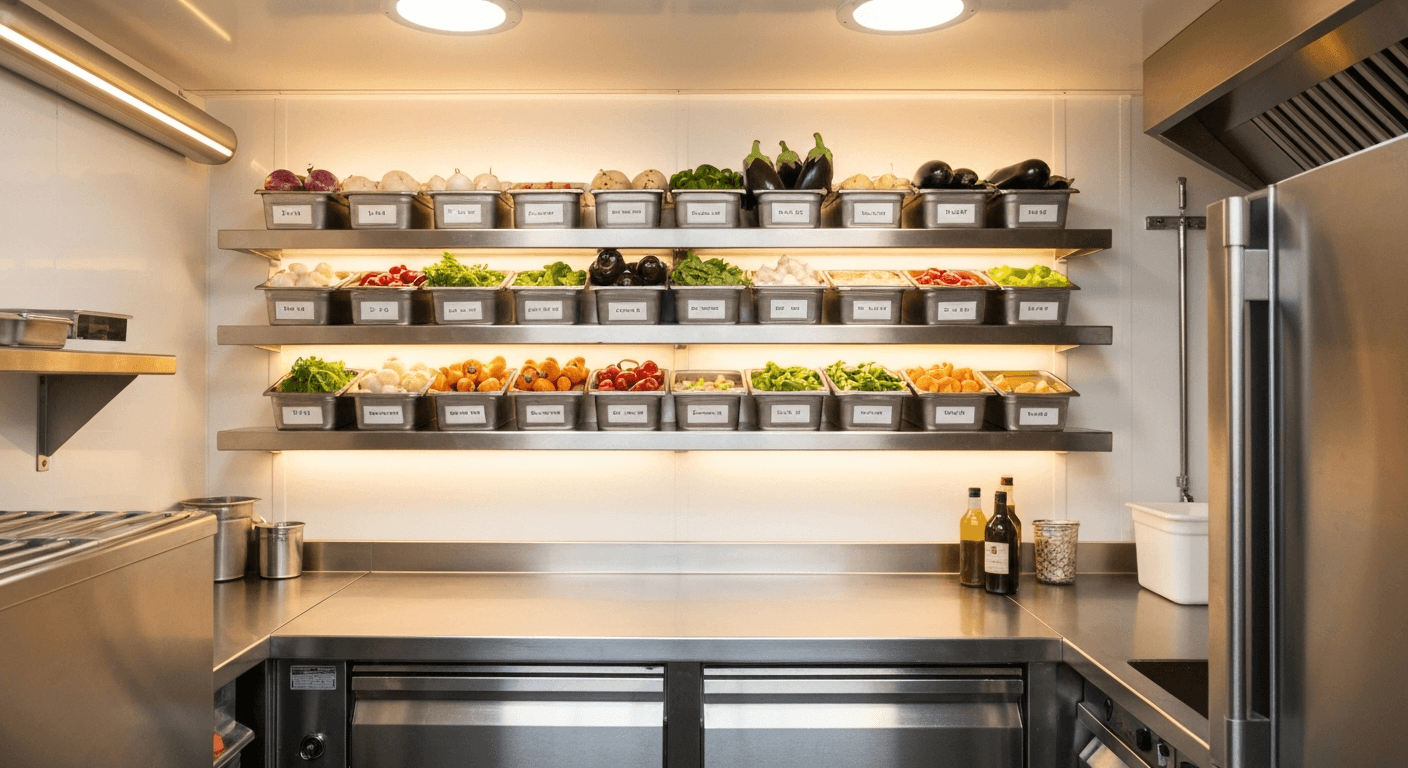
Organise your space into three concentric zones:
- Immediate zone (within reach without moving): ingredients used on more than 50% of orders, packaging, main sauces
- Close zone (one step or rotation): secondary ingredients, drinks, garnishes
- Far zone (restocked between services): reserve stock, rarely used equipment
Mise en Place (Prep Work)
Mise en place is not reserved for starred restaurants. Before each service, prepare:
- Pre-weighed and portioned ingredients for your best-selling dishes
- Sauces in ready-to-use squeeze bottles (not to be opened mid-service)
- Pre-opened or pre-assembled packaging (lids already placed on containers)
- Pre-cut garnishes in quantities calculated from your forecasts
Step 4 — Manage the Queue Intelligently
Queue management influences the perception of waiting as much as the actual time. Studies in quick-service restaurants show that customers overestimate their wait time by 20 to 40% when they have nothing to do.
Communicate the Wait Time
Announce the estimated time as soon as the queue exceeds 5 or 6 people. "About 10 minutes" said out loud reduces anxiety and limits walk-aways. Customers who know how long they are waiting are far more patient than those who do not.
Take Orders in Advance Down the Queue
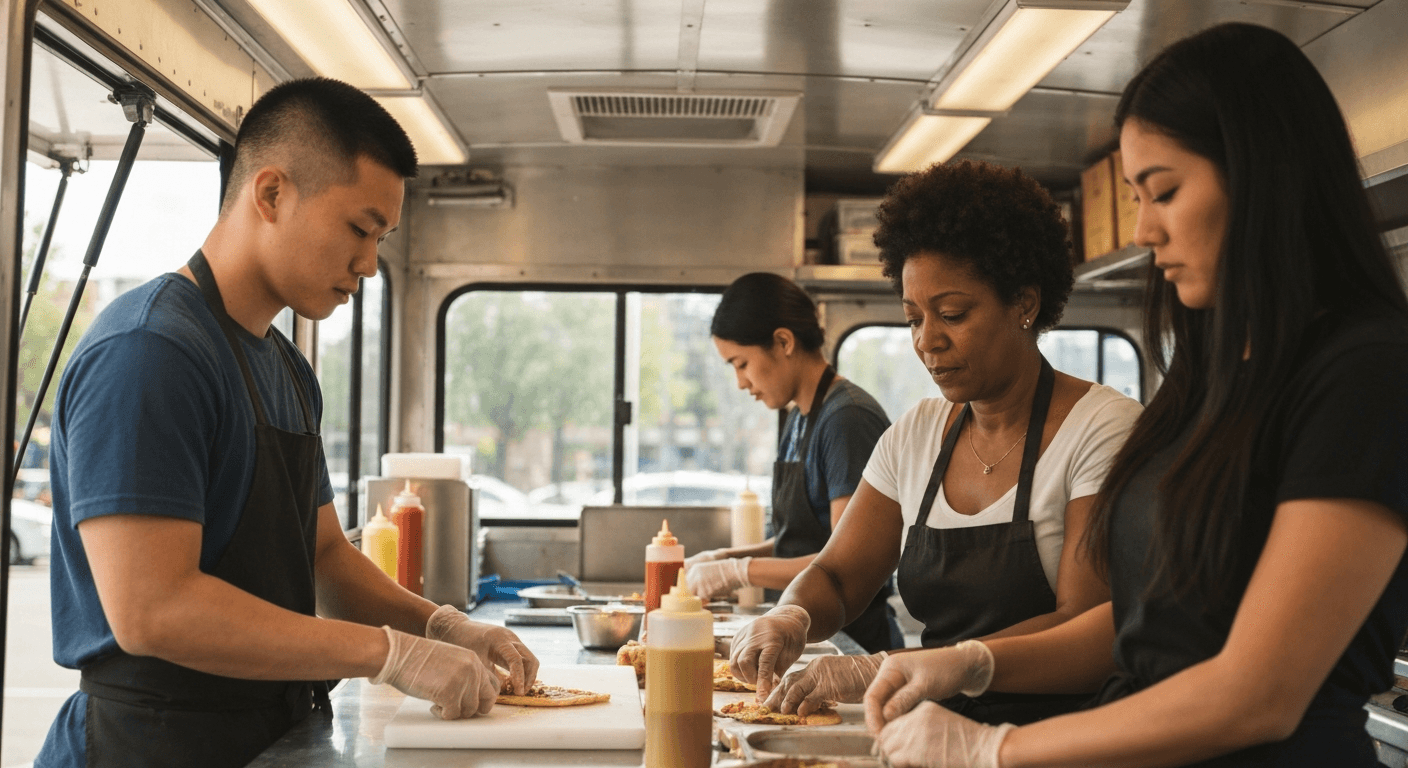
If there are two of you, send one person to take orders in the queue while the other prepares. By the time the customer reaches the window, their order is already being made. This technique, used in fast food since the 1990s, can double your throughput during busy slots.
Offer Pre-Order via QR Code
A QR code displayed at the start of the queue that lets customers pre-order and pre-pay reduces both order-taking time and payment time. Solutions like Square, Laddition or even a simple link to your payment system let you set this up without major investment.
Keep People Engaged While They Wait
Music, a menu that is visible and readable from far away, a large-format "dish of the moment" display — anything that gives customers something to do while waiting reduces the perception of how long it takes.
Step 5 — Adapt Your Menu to Throughput Constraints
Your menu is not just a culinary offering: it is an operational tool. Some dishes are naturally faster to prepare than others. During high-pressure slots (weekday lunch on an industrial estate, packed festival), favour a reduced menu of the fastest dishes.
The Lunchtime "Express" Menu
On your highest-footfall slots, offer a reduced menu of 3 to 4 dishes with a preparation time under 2 minutes. Time-pressed customers appreciate the simplicity, and you stay in control of your throughput.
Identify Your "Bottleneck" Dishes
Some dishes are delicious but slow to prepare (complex assembly, long cooking time). On your busiest services, remove them from the menu or cap their daily quantity. FoodTracks lets you cross-reference sales data by dish and by time slot to identify exactly which ones are profitable without penalising your throughput.
What the Data Says: Realistic Targets
Here are concrete benchmarks for a well-run solo food truck:
| Indicator | Suboptimal | Good | Optimised | |-----------|-----------|------|-----------| | Average service time | >4 min | 2 to 3 min | <2 min | | Queue abandonment rate | >15% | 5 to 10% | <5% | | Covers per peak hour | <20 | 25 to 35 | 40+ | | Share of contactless payment | <40% | 60 to 75% | >85% |
These figures vary by cuisine type and service format. They are benchmarks, not absolute targets.
Practical Tools to Go Further
Visible Service Timer
Place a timer visible from your workstation and time your own services for a week. Seeing the figure in real time creates positive pressure and helps identify orders that run over.
FoodTracks for Time-Slot Analysis
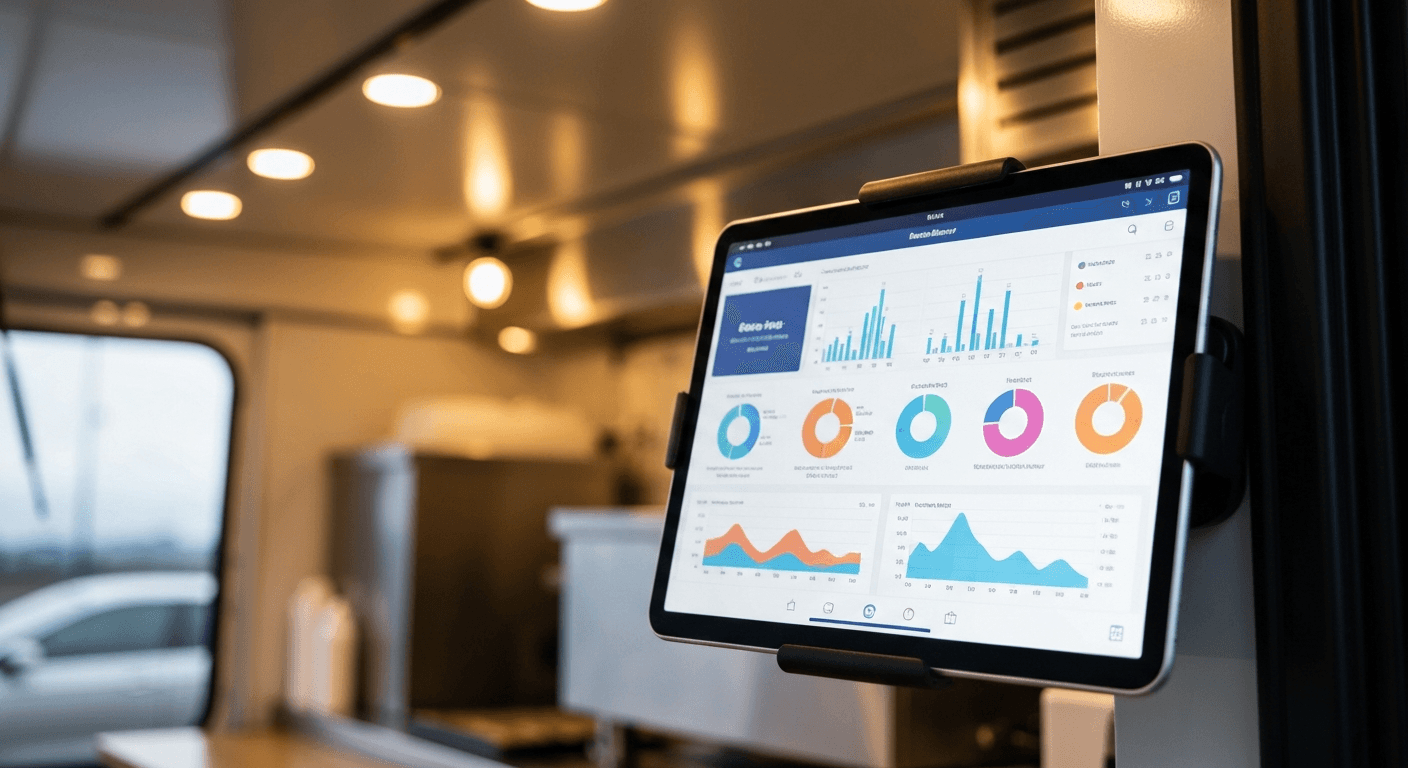
By cross-referencing your SumUp sales with timestamps, FoodTracks lets you identify your peak slots, compare throughput from one service to the next and measure the impact of your organisational changes on real profitability.
The 5-Minute Post-Service Review
After every busy service, take 5 minutes to note: what caused a block? When did the queue stall? Which dish caused the most delay? This simple habit, kept up for a month, gives you more insight than an external consultant.
Conclusion
Reducing your service time is not about personal speed: it is about systems. By measuring your times, identifying your real bottlenecks, reorganising your workspace and managing queue perception, you can serve 30 to 50% more customers in the same slot without working harder.
The best investment is not always a second employee: it is often one hour spent analysing and reorganising your workstation.
Also read: Increasing Your Average Basket at Your Food Truck · Food Truck Weekly Planning · Food Truck Dashboard: Managing Profitability
Frequently Asked Questions
- What is the maximum acceptable wait time for a food truck customer?
- Beyond 8 to 10 minutes, a significant proportion of customers abandon the queue, especially during lunchtime slots where workers have limited break time. The target to aim for is an average service time of under 3 minutes per customer, which allows queues of 10 to 15 people to be absorbed without reaching that critical threshold.
- How do you speed up service at a food truck without hiring a second employee?
- The most effective levers without hiring are: reducing the number of dishes on the menu during busy slots (3 to 4 express dishes), rigorous mise en place before service (pre-weighed portions, pre-opened packaging), separating the order point from the hand-off point, and encouraging contactless payment. These measures alone can cut service time by 30 to 50%.
- How do you manage a long queue at a festival or large event?
- Three priority actions: announce the estimated wait time out loud as soon as the queue exceeds 8 people, send someone to take orders in the queue (if there are two of you), and offer a reduced menu of the 3 fastest dishes to prepare. If possible, set up a ticket number system or QR code pre-order before the event to smooth the flow.
- How do I know whether it is preparation or order-taking that is slowing down my service?
- Time each phase separately across around twenty orders during a busy service. If the window is free and you are waiting in the kitchen, preparation is the bottleneck. If the kitchen is ready before the customer has finished ordering or paying, it is order-taking or payment. This 30-minute measurement exercise will give you a definitive answer and focus your optimisation efforts in the right place.
- Are online pre-order solutions worth it for a food truck?
- On recurring fixed locations (weekly market, regular industrial estate), yes. A pre-order QR code displayed at the start of the queue can reduce till time by 60 to 70% on prepared orders. At one-off event locations, the return on investment is less clear because customers are unfamiliar with the system. Start with your most regular locations.