Why Gross Margin Is the #1 Metric for Food Truckers
When it comes to food truck profitability, revenue turns heads — but gross margin tells the real story. A truck pulling in €8,000 a month with 40% food cost earns far less than one doing €6,000 at 28% food cost.
Gross margin measures what's left after paying for your ingredients, before all other expenses (rent, fuel, labour, insurance). It's the foundation of your entire financial equation.
Understanding, calculating and improving your gross margin is the single most profitable financial skill a food trucker can develop.
The Exact Formula to Calculate Your Gross Margin
Key definitions
- Revenue: total sales (ex-VAT) for the period
- Cost of goods sold (food cost): value of ingredients consumed to generate those sales
- Gross margin: revenue − food cost
``` Gross margin (€) = Revenue (ex-VAT) − Cost of goods sold Gross margin rate (%) = (Gross margin ÷ Revenue) × 100 ```
Concrete example
You generate €7,500 ex-VAT in weekly revenue. Your consumed raw material cost is €2,100.
- Gross margin = 7,500 − 2,100 = €5,400
- Gross margin rate = (5,400 ÷ 7,500) × 100 = 72%
What Are Good Gross Margin Rates for Food Trucks?
Industry benchmarks vary by concept, but here are the reference points used by mobile catering professionals:
| Gross margin rate | Interpretation | |---|---| | < 60% | Dangerous — food cost too high | | 60–65% | Watch out — little room for error | | 65–72% | Solid — target zone for most concepts | | 72–78% | Excellent — well-controlled food cost | | > 78% | Outstanding — typical of drinks, simple snacks |
A burger truck typically lands at 68–72%, a pizza truck at 70–75%, a smoothie truck up to 78–82%.
Beware of comparisons: your target rate depends on your concept, pricing and positioning. What matters is measuring your own rate consistently and improving it over time.
How to Calculate Your Food Cost Accurately
Food cost calculations are often approximate, skewing the entire analysis. Here is the rigorous method:
Consumed purchases method
``` Actual food cost = Opening stock + Purchases in period − Closing stock ```
Example:
- Stock at the start of the week: €800
- Purchases during the week: €1,800
- Stock at the end of the week: €500
- Actual food cost = 800 + 1,800 − 500 = €2,100
Recipe card method
Calculate the cost price of each recipe by itemising every ingredient:
- Signature burger: bun (€0.35) + patty (€1.80) + cheese (€0.25) + vegetables (€0.20) + sauce (€0.10) = €2.70
- Selling price ex-VAT: €9.50
- Unit food cost: 2.70 / 9.50 = 28.4%
Automate with FoodTracks
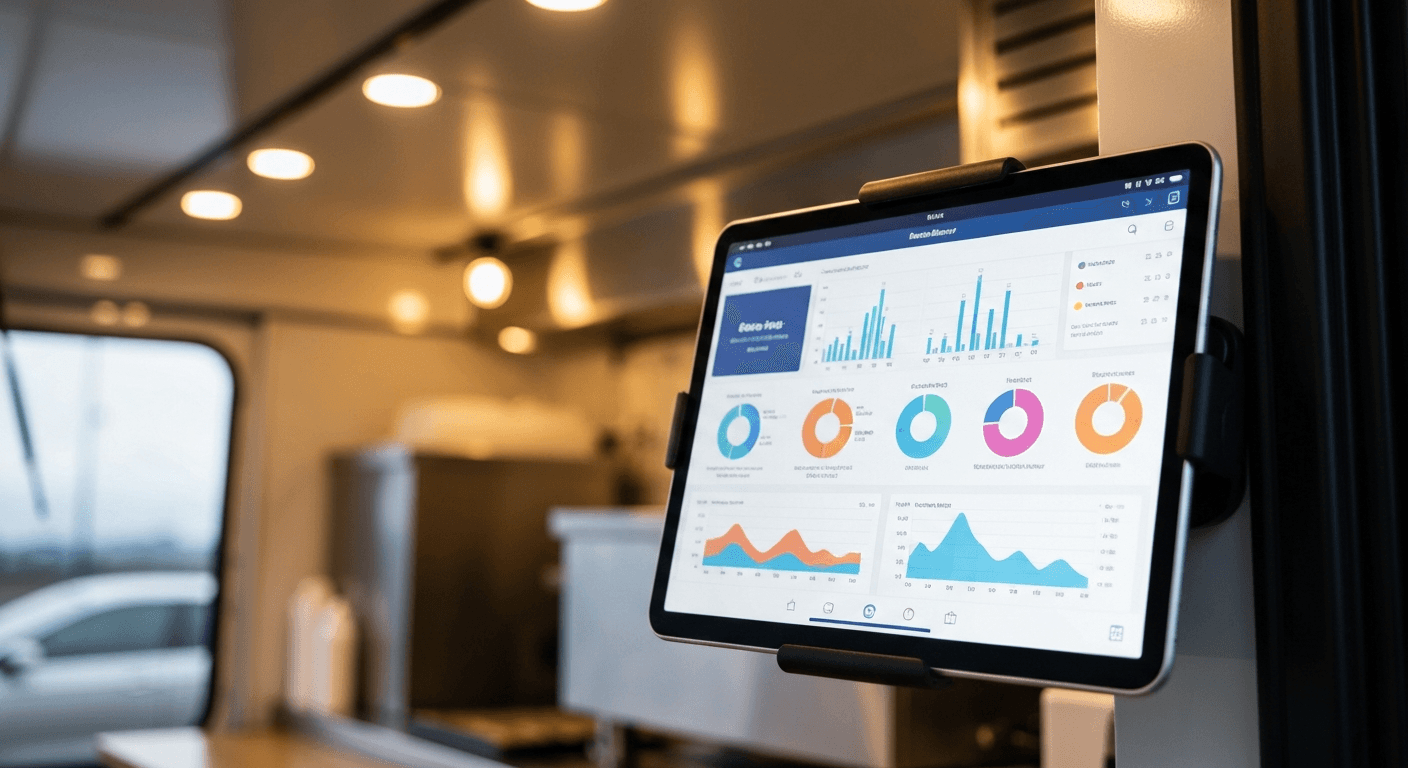
Doing this calculation manually every week takes time and produces errors. FoodTracks imports your supplier invoices via scan, tracks your SumUp sales in real time, and automatically calculates your food cost and gross margin rate after every service.
6 Levers to Improve Your Gross Margin
1. Build accurate recipe cards for every dish
Recipe cards are the foundation of everything. Without them, you cook by feel and your food cost swings every service. For each recipe:
- Weigh every ingredient (never "eyeball it")
- Factor in losses (peeling, cooking, trimming)
- Update prices regularly (commodity prices fluctuate)
2. Practice menu engineering
Not all your dishes perform equally on margin. Menu engineering classifies your items into 4 categories:
- Stars: high margin + high popularity → feature them prominently
- Cash cows: high margin + moderate popularity → add value to them
- Question marks: low margin + high popularity → rework the price or recipe
- Dogs: low margin + low popularity → remove them
3. Negotiate with your suppliers
Your purchase prices have a direct and immediate impact on food cost. A few rules:
- Get quotes from 2 to 3 suppliers per category
- Negotiate volume discounts on high-turnover items
- Pay cash if you can — it's often negotiable as an additional discount
- Bundle orders to reduce delivery charges
4. Control portions
Portion drift is the silent enemy of gross margin. When a team member serves 180g of fries instead of 150g, that's 20% extra food cost on that dish — invisible but systematic.
Solutions:
- Use kitchen scales
- Standardise utensils (calibrated ladles, dosing spoons)
- Train your team on the importance of the standard portion
5. Reduce waste
Food waste directly cuts into your gross margin. In mobile catering, it represents on average 8 to 15% of purchases.
- Adjust orders to your locations (a village market ≠ a festival)
- Create "specials" using ingredients approaching their best-before date
- Track losses in real time to identify problem products
6. Revisit your selling prices
Sometimes the simplest solution is also the most underused: raise your prices. If your food cost is at 35%, moving a burger from €10 to €10.50 improves your gross margin by nearly 3 points without changing a single gram of ingredient.
Menu psychology, positioning and communicating your quality are your allies for adjusting prices without losing customers.
Gross Margin vs Net Margin: Don't Confuse Them
Gross margin is essential but insufficient for assessing the real profitability of your food truck. Net margin (or net profit) incorporates all expenses:
``` Net margin = Gross margin − Fixed and variable costs (excl. materials) ```
These additional costs include: truck lease, fuel and tolls, insurance, labour, pitching fees, loan repayments, administrative costs…
In food trucking, a net margin rate of 15 to 25% is considered healthy. If your gross margin is at 70% and your net margin at 8%, your fixed costs are too high — that's a separate problem to address.
Setting Up Monthly Gross Margin Tracking
Gross margin isn't calculated once a year — it's tracked every week, ideally after every service:
- End of service: record sales (via your SumUp terminal or POS)
- Every week: take stock to calculate actual food cost
- Every month: compare against your target and identify variances
With FoodTracks, this dashboard is automated. You see your gross margin in real time, by location, by dish and by period — without spending hours in a spreadsheet.
Conclusion
Gross margin is the health thermometer of your food truck's finances. Calculating it correctly, benchmarking it and improving it methodically transforms your activity from a "passion job" into a genuinely profitable business.
The 6 levers — recipe cards, menu engineering, supplier negotiation, portion control, waste reduction and price revision — require no major investment. They require rigour and reliable data.
Start by measuring. Then optimise.
Frequently Asked Questions
- What is the difference between gross margin and net margin in a food truck?
- Gross margin = revenue − cost of goods sold. It measures what's left after ingredients. Net margin = gross margin − all other costs (rent, fuel, labour, insurance, loans). In food trucking, a healthy gross margin is 65–75%, a healthy net margin 15–25%.
- What is a good food cost percentage for a food truck?
- A good food cost for a food truck is between 25% and 35% of ex-VAT revenue, corresponding to a gross margin of 65% to 75%. Below 25%, you have exceptional margin (typical of drinks). Above 40%, profitability is seriously at risk.
- How can a food truck quickly reduce its food cost?
- The 3 fastest actions: 1) Build accurate recipe cards with systematic weighing (immediate 2–5 point gain). 2) Do a weekly stock-take to identify actual waste. 3) Negotiate with your main suppliers using your volume data. Combined, these actions can cut food cost by 5 to 10 points in 30 days.
- Should you calculate gross margin per dish or overall?
- Both levels are complementary. The overall calculation (weekly or monthly) shows the overall health of the business. Per-dish calculation (via recipe cards) enables menu engineering: identifying profitable dishes to push and ones to rework. Start with the overall, then drill down to dish level to optimise.
- Can you improve gross margin without raising prices?
- Yes, absolutely. The main levers without price increases: reduce waste (8–15% of purchases on average), control portions (a 20% overrun per dish adds up fast at scale), negotiate with suppliers (5–10% reduction achievable), optimise product mix by pushing high-margin dishes. These levers can improve gross margin by 5 to 10 points without touching prices.