Summer: A Goldmine — and a Stock Management Headache
Summer is often a food trucker's best season: festivals, outdoor markets, tourist hotspots, pop-up food courts… footfall spikes, queues grow longer, average spend climbs. But this excitement hides a real challenge: managing stock that must adapt to demand two or three times higher than usual, in an environment where heat accelerates product spoilage.
Without a solid strategy, summer can quickly turn into a nightmare: wasted products from poor rotation, stockouts on your best-sellers at peak service, margins shrinking just as the season heats up.
Why Summer Complicates Food Truck Stock Management
Higher demand — but far more volatile
A seaside market in July might serve 500 covers on a blazing Sunday and just 80 on a rainy one. Summer events (festivals, concerts, flea markets) concentrate footfall into short, unpredictable windows.
If you order like you do in March, you'll either run dry by 1pm or end the day with 40% of your stock unsold.
Heat is your fresh produce's worst enemy
Above 20°C ambient temperature, the shelf life of most fresh products is cut in half. Inside a truck parked in direct sunlight, your fridges work overtime and struggle to maintain the cold chain on the most sensitive items: minced meat, fish, fresh dairy, pre-portioned ingredients.
Suppliers face pressure too
During peak season, deliveries can be delayed. Local producers — often preferred in summer for seasonal vegetables — have limited capacity. Ordering the night before for next-day delivery is riskier than in the off-season.
5 Concrete Strategies to Control Your Stock This Summer
1. Mine your data from previous summers
The best compass for ordering right is your own history. Review your sales data from past summers and ask three questions:
- Which were your 5 best-selling dishes in July and August?
- At which locations did your footfall vary most from one day to the next?
- Which products did you waste the most — or run out of?
2. Build standard order sheets by summer event type
Not all summer services look the same. A 10,000-person music festival calls for very different orders than a weekday farmer's market. Build specific order templates by event type:
| Event type | Multiplier vs. your baseline | |---|---| | Standard neighbourhood market | × 1 | | Tourist area in peak season | × 1.4 | | Festival or large-format event | × 2 to 2.5 | | Evening market / night event | × 1.2 |
Calibrate these multipliers to your own history — they're starting points, not universal rules.
3. Double down on FIFO, especially for high-risk products
The FIFO method (First In, First Out) is always recommended, but it becomes critical in summer. When temperatures rise, a badly rotated product can become unsafe within hours.
Set strict rules in your truck:
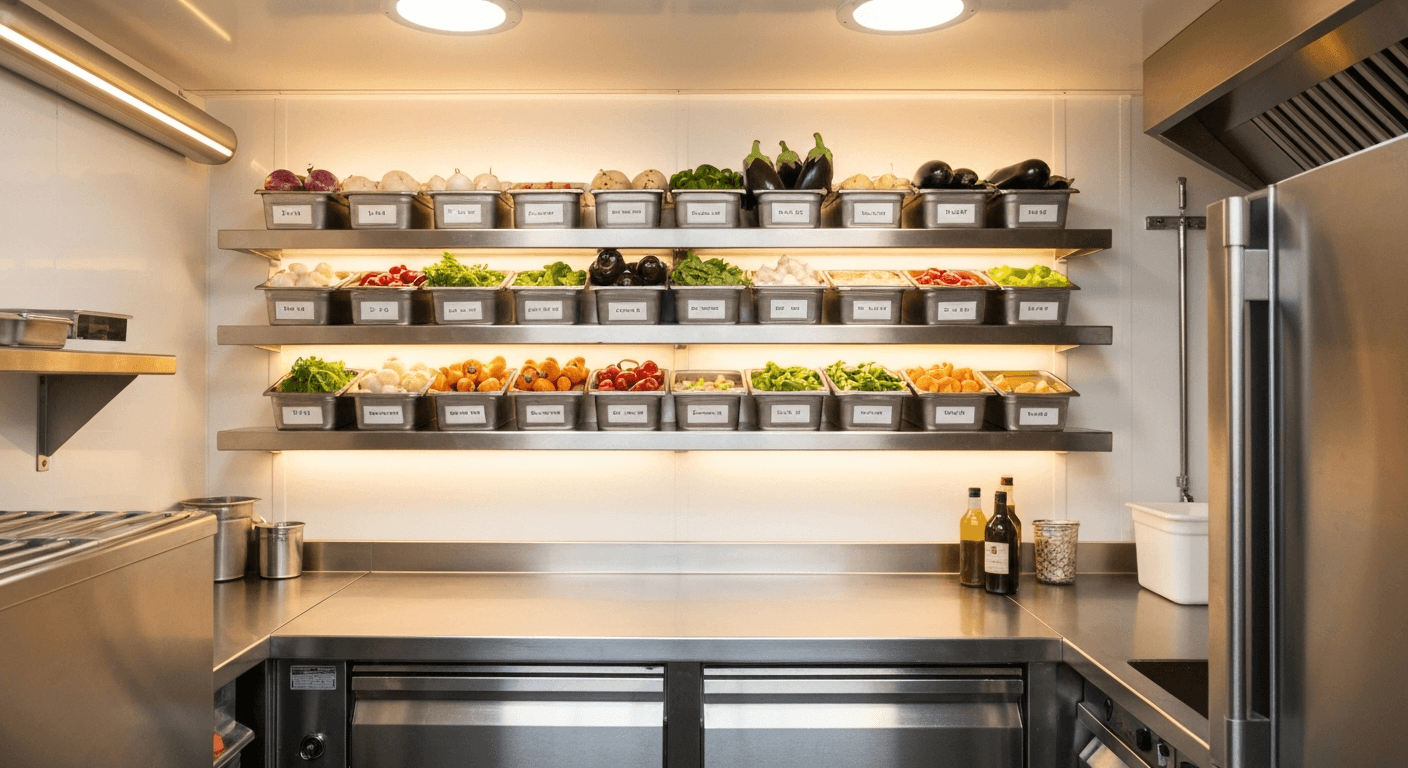
- Systematic labelling with date and time of receipt
- Fridge organised as a flow: new stock at the back, oldest products at the front
- Visual and smell check at the start of every service
- Zero-tolerance policy: when in doubt, throw it out. A foodborne illness in summer can destroy a reputation in 24 hours.
4. Design a "safety net" menu
Even with the best organisation, you will face a stockout at some point. Having a pre-planned backup menu saves you from shutting the hatch mid-service.
Designate 2 or 3 dishes that can be assembled from always-available ingredients (shelf-stable products, quality frozen alternatives). These fallback options keep you trading even if your hero dish runs out.
5. Shift from reactive to predictive ordering
Reactive management — ordering after you've spotted shortages — doesn't work in peak season, when delivery lead times are longer and mistakes are costlier. Switch to predictive mode: combine your sales history with your location schedule, weather forecast, and event type to estimate what you'll need before placing each order.
That's exactly what FoodTracks' forecasting module does: by aggregating your past sales data, weather conditions, and location type, it generates an order estimate for each service. Less time guessing, fewer stockouts, less waste.
Products to Watch Most Closely
Some categories are particularly at risk during peak summer season:
- Fresh meat and protein: shortened shelf life, high food safety risk in heat
- Dairy products (fresh cheeses, creams): sensitive to temperature fluctuations inside a truck
- Pre-cut vegetables: oxidise rapidly once unwrapped
- Drinks: demand spikes in summer but they're bulky to store — manage your drink rotation with the same rigour as your ingredients
A Profitable Summer Is Prepared Before June
Peak summer season is won or lost in the weeks that precede it. Before the June rush, take time to:
- Review your sales data from last summer
- Update your order sheets by event type
- Organise your storage space for optimal FIFO flow
- Brief (or remind) your team on rotation best practices
- Set up expiry alerts if you use a management tool like FoodTracks
Read next: Complete guide to food truck stock management · Optimise your food truck stock rotation · Adapt your food truck menu to the weather
Frequently Asked Questions
- How do I calculate the right stock quantity for a summer festival?
- Start from your average consumption per service, then apply a multiplier based on event type: × 2 to 2.5 for a major festival, × 1.4 for a tourist location in high season. Refine these multipliers using your own data from previous summers. A forecasting tool like FoodTracks automates this calculation by combining your sales history and location type.
- Which food truck products are most at risk of waste during summer?
- The highest-risk products in summer are fresh and minced meats (shelf life drastically reduced above 20°C), fresh dairy products, pre-cut vegetables, and ready-to-use preparations. These categories require strict FIFO rotation, labelling with date and time of receipt, and a sensory check at the start of each service.
- Should I order more frequently during peak summer season?
- Yes, more frequent orders (2 to 3 times a week rather than once) let you better match quantities to actual demand and reduce dormant stock. In return, confirm your suppliers guarantee reliable delivery lead times in season — a slipping lead time can cancel out the benefit of ordering more often.
- How can I avoid stockouts on my best-selling dishes mid-summer service?
- Three combined levers work well: (1) use history-based forecasts to order correctly before each service, (2) set an internal stock alert threshold (e.g., signal the team when a hero dish drops below 20 portions), (3) prepare a substitute dish from always-available ingredients. Zero stockouts doesn't exist, but a well-prepared Plan B stops you from losing customers.
- Can you freeze fresh products to avoid waste in a food truck in summer?
- Yes, under certain conditions. Uncooked meats, doughs, house sauces, and some preparations can be frozen if you have an onboard freezer or a central storage facility. Always respect the cold chain during transport and HACCP regulations on freezing fresh products. Freezing is a safety net, not a primary stock management strategy.