Why Industrial Zones Are a Gold Mine for Food Trucks
Industrial zones and business parks are full of employees who eat on-site, often with no nearby alternative. At lunchtime, a well-positioned food truck can serve 60 to 120 covers in 90 minutes — with customers who come back every week.
Yet fewer than 20% of food truckers tap into this opportunity. The main reason: a lack of understanding about how to access these sites and what contracts to sign.
The Rules: Private Land vs Public Road
The first thing to understand is fundamental: an industrial zone is almost always private land.
On a public road (rarely the case in industrial zones)
If the road serving the zone is a municipal or departmental road, you need a temporary occupation permit for public land from the local council. The rules are the same as for a regular market.
On private land (the typical case)
In industrial zones, roads and car parks usually belong to:
- The zone developer or manager (such as a mixed-economy company or an inter-municipal authority)
- A syndicate association of the businesses in the zone
- One of the companies if the zone has a single owner
How to Get Access to an Industrial Zone
1. Identify the site manager
Start by contacting the local Chamber of Commerce and Industry (CCI) or the municipality's website: they usually list business zones and their managers. You can also go directly to the largest company in the zone.
2. Negotiate an occupation agreement
Once you've identified the manager, propose a précaire et révocable occupation agreement (standard French legal term for a temporary permit). This document should specify:
- Operating days and hours
- The exact location (with a map)
- Duration (often 1 year, renewable)
- The monthly fee or percentage of revenue
- Your obligations (cleanliness, waste management, professional liability insurance)
3. Take out appropriate professional liability insurance
Your professional liability insurance must cover your activity on third-party private land. Check this point explicitly with your insurer: some policies exclude private land outside of market settings.
Strategy to Maximise Sales in an Industrial Zone
Know the lunch break schedule
Every zone has its own rhythms. In a mixed industrial zone (logistics + office), you'll typically see:
- A wave from 12:00–12:30 (office employees)
- A wave from 12:30–13:15 (operators, warehouse staff)
Adapt your menu to the zone profile
The employees' profile determines your ideal offer:
| Zone type | Dominant profile | Recommended menu | |---|---|---| | Logistics / warehouses | Manual workers, operators | Burger, kebab, rice dish — high volume, under €10 | | Business park | Office staff, executives | Composed salad, wrap, hot dish — premium €10–13 | | Mixed industrial zone | Varied profiles | Two price ranges, 4–6 items |
Build loyalty through consistency
In an industrial zone, your biggest asset is consistency. Come on the same days, at the same times. Employees plan their lunch in advance: if they know you're there on Tuesday and Thursday, they won't bother looking for an alternative.
A simple loyalty programme (stamp card or QR code) can increase your return rate by 15–25% within the first quarter.
Communicate internally
Offer to let the HR manager or site coordinator share your schedule on the intranet or by email. Some companies have a notice board at the entrance or a staff WhatsApp group. A simple announcement — "The food truck is here Tuesday and Thursday 12pm–1:30pm" — can double your footfall.
Calculate Profitability Before Signing
Before signing an agreement, estimate your potential:
Revenue potential = (Zone headcount × capture rate) × average spend
Example:
- Zone: 400 employees
- Realistic capture rate (20%): 80 covers per service
- Average spend: €9
- Revenue per service: €720
- 2 services/week × 45 weeks: €64,800/year
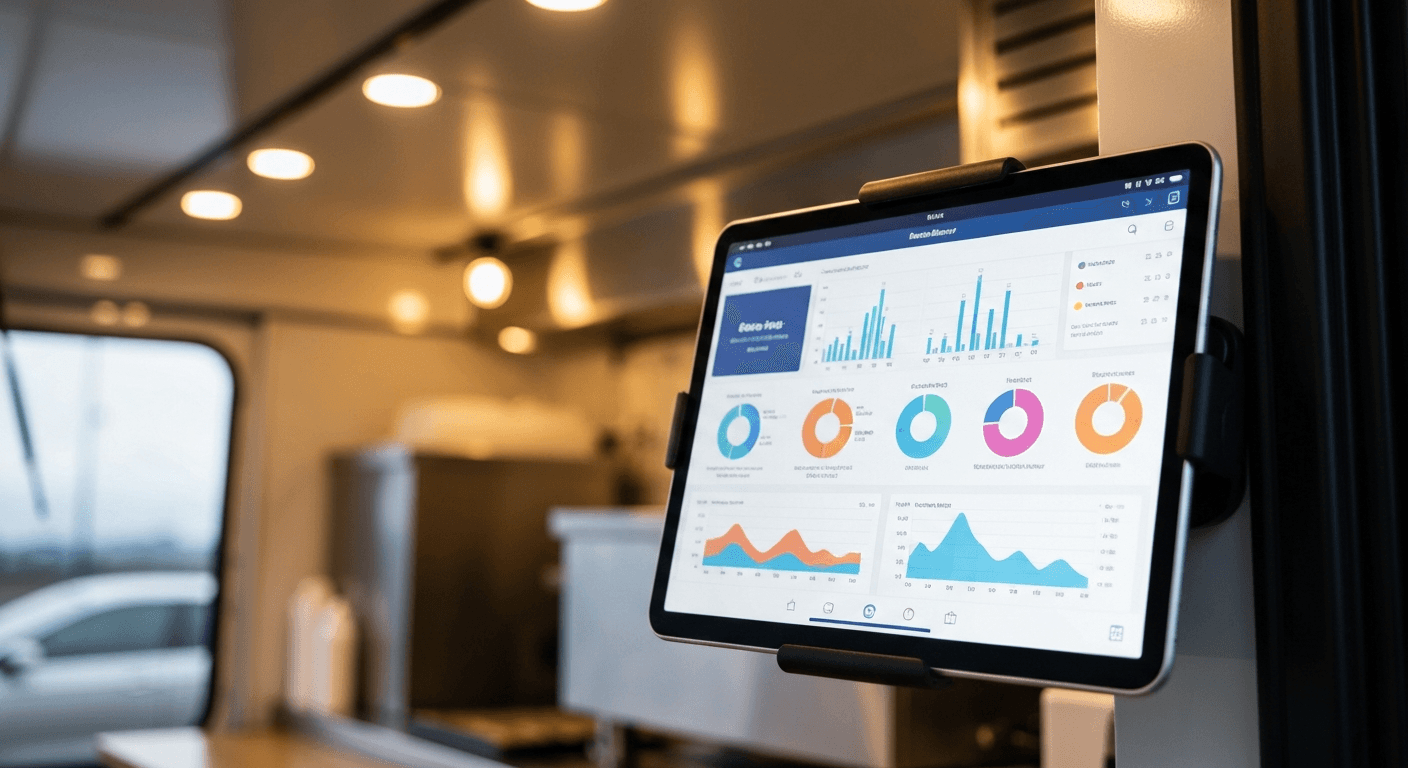
With FoodTracks, track your revenue per location in real time to compare your business parks and decide where to focus your energy.
FAQ — Food Truck in an Industrial Zone
Do you need a council permit to operate in an industrial zone?
No, if the zone is on private land (which is typically the case). You only need written permission from the landowner or zone manager. If the access road is a municipal road, a public land occupation permit may be required.
Can you be refused access to an industrial zone?
Yes. The landowner is free to refuse without giving a reason. To maximise your chances: show that you're meeting a real need (survey the employees), propose a one-month trial period, and highlight the benefit to the manager (service for occupants, improved zone attractiveness).
What fee should you propose for a business park pitch?
Start by proposing €50–150/month for a small zone (under 200 employees), or 3–5% of revenue for a larger site. Avoid proposing €0: some managers will refuse for fear of setting a precedent or taking on liability.
Conclusion
An industrial zone is the ideal location for a food truck seeking a regular, predictable, low-competition customer base. By understanding that you're operating on private land and preparing a proper agreement, you can secure one or two recurring locations that form the backbone of your revenue.
Track your performance location by location with FoodTracks and quickly identify your most profitable zones.
Read next: Choose a profitable location · Food truck parking permits · Corporate food truck catering
Frequently Asked Questions
- Do you need a council permit to work in an industrial zone?
- No, if the zone is on private land (which is the typical case). You only need written permission from the landowner or zone manager. If the access road is a municipal road, a public land occupation permit may be required.
- What fee should you propose for a pitch in a business park?
- Propose €50–150/month for a small zone (under 200 employees), or 3–5% of revenue for a larger site. Avoid proposing €0: some managers will refuse for fear of setting a precedent.
- How many covers can you expect in an industrial zone?
- A capture rate of 15–25% of the zone's workforce is realistic after a few weeks of consistent presence. For a zone of 300 employees, that's 45–75 covers per service — or €400–675 in revenue per service with an average spend of €9.
- Can you access multiple industrial zones at the same time?
- Yes, and it's actually recommended. Many food truckers operate across 2–4 different zones in the same week, alternating days. Track your revenue by location with a tool like FoodTracks to identify which ones are worth keeping.